Government Meeting Systems for China's IT Localization | GZZHYUN
Why Government Meeting Systems Matter in China's IT Localization China's transition toward domestically developed information technology is entering a more adva
Why Government Meeting Systems Matter in China's IT Localization
China's transition toward domestically developed information technology is entering a more advanced stage.
For government agencies, state-owned enterprises, and critical infrastructure organizations, IT localization is no longer limited to replacing office computers or individual software applications. It now covers processors, operating systems, databases, middleware, business applications, and hardware terminals.
Government meeting systems are a particularly important part of this transition because they handle sensitive information such as executive decisions, personnel arrangements, policy discussions, project evaluations, and operational instructions.
A secure government paperless meeting system must therefore provide more than a localized software interface. It requires full-stack compatibility with China's domestic IT ecosystem, reliable security controls, traceable system operations, and practical tools for daily meeting management.
Why Government Meeting Systems Require Stronger Security
A modern government meeting room brings together participants, documents, devices, audio, video, voting results, annotations, and decision records.
This creates several information security and management challenges.
Sensitive Meeting Information
Government and state-owned enterprise meetings may involve confidential documents, strategic decisions, financial information, personnel matters, or critical operational plans.
If meeting materials are distributed through unsecured channels or stored on systems outside the organization's control, there may be risks involving unauthorized access, information leakage, and incomplete audit records.
Technology Supply Chain Risks
Meeting terminals that depend entirely on imported processors, operating systems, databases, or software platforms may create procurement and maintenance risks.
Organizations must consider whether the selected technology can receive reliable long-term support and whether the underlying infrastructure remains controllable throughout the system's lifecycle.
Data Storage and Control
Meeting systems generate large volumes of important data, including:
- Participant information
- Meeting documents
- Discussion records
- Voting results
- Annotations
- Audio and video recordings
- Final decisions
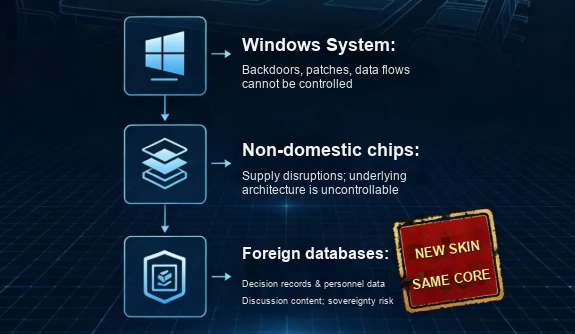
Storing this information in an unsuitable database environment may create data security, governance, and compliance concerns.
Compliance and Audit Requirements
China's Multi-Level Protection Scheme 2.0, commonly known as MLPS 2.0, and security requirements for confidential meetings place greater emphasis on access control, role separation, audit trails, data protection, and accountability.
Government meeting systems must support these requirements before, during, and after every meeting.
Why Basic Software Compatibility Is Not Enough
Some meeting systems are described as domestically compatible simply because the application has been localized or can be installed on a domestic operating system.
However, the underlying system may still depend on imported processors, databases, middleware, or hardware components.
This type of surface-level adaptation does not provide genuine full-stack control. It may also create performance problems, unstable operation, or compliance gaps during government technology reviews.
A complete IT localization strategy should cover:
- Processor architecture
- Operating system
- Database
- Middleware
- Application software
- Meeting terminals
- Security controls
- Audit functions
- Data storage and deletion
The goal is not simply to replace one product with another. It is to build a stable, secure, and maintainable meeting environment across the entire technology stack.
Zhihui Cloud's Full-Stack Government Meeting Solution
Guangzhou Zhihui Cloud Technology Co., Ltd. specializes in developing paperless meeting software and hardware for government agencies, public institutions, and enterprise organizations.
Its domestically compatible paperless meeting system connects processors, operating systems, databases, middleware, applications, and meeting terminals within a unified platform.
Compatibility with Domestic Processors
Zhihui Cloud supports domestically developed CPU architectures including:
- Phytium
- Kunpeng
- Zhaoxin
This gives organizations greater flexibility when selecting domestic processors for meeting terminals and related infrastructure.
It also helps reduce dependence on a single technology architecture and improves long-term control over the meeting system supply chain.
Support for Domestic Operating Systems
The system is adapted for domestic operating systems including:
- Kylin
- UnionTech UOS
- HarmonyOS
The adaptation is designed to go beyond basic software installation. System-level optimization helps improve performance, operating stability, and power efficiency across supported devices.
Domestic Database Integration
Zhihui Cloud can integrate with domestic database platforms such as:
- Dameng Database
- KingbaseES
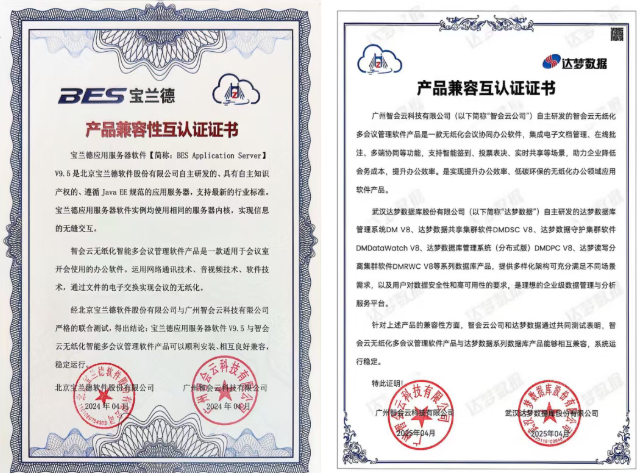
Meeting records, participant information, documents, and related data can therefore be stored and managed within a domestic database environment.
This helps organizations create a more consistent approach to data control, access management, and long-term information storage.
Domestic Middleware Compatibility
The platform also supports middleware products from domestic providers including:
- Primeton
- TongTech
- Baolande
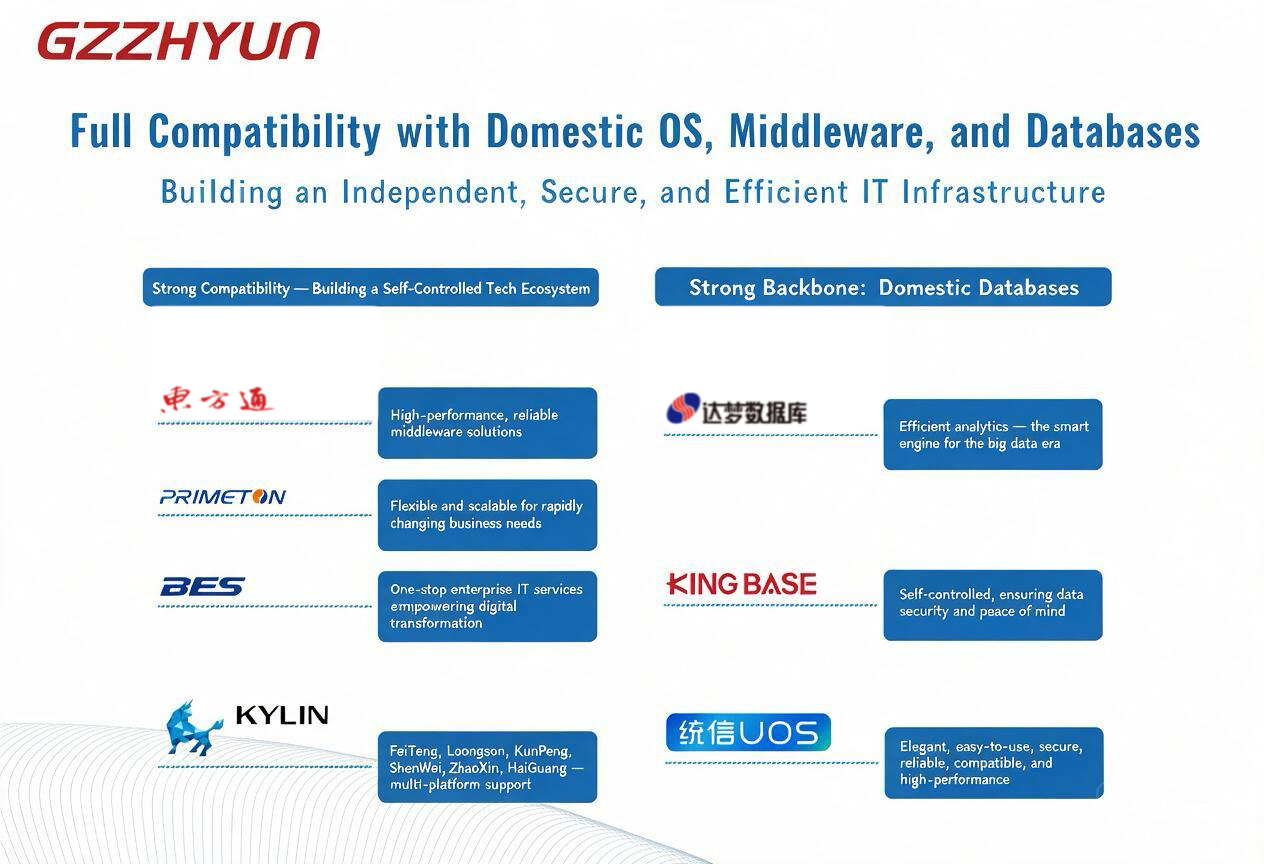
Middleware compatibility is essential when the meeting platform needs to connect with existing government information systems, internal applications, or other digital management platforms.
Domestically Compatible Meeting Hardware
Zhihui Cloud provides meeting hardware ranging from CNC-machined aluminum motorized display terminals to desktop all-in-one devices with integrated microphones.
The product line uses domestic component solutions to improve supply chain control and create a more consistent software and hardware environment.
This integrated approach allows the software, operating system, processor, database, and meeting terminal to work together as a complete solution.
Security Controls for Confidential Meetings
Domestic technology compatibility alone is not enough. A government paperless meeting system must also protect information throughout the entire meeting lifecycle.
Three-Role Administration
Zhihui Cloud supports a three-role administration model consisting of:
- System Administrator: Manages users, organizational structures, devices, and system settings
- Meeting Administrator: Manages meetings, participants, documents, permissions, and meeting operations
- Auditor: Independently reviews system activities and operation records
Separating these responsibilities prevents a single administrator from controlling every part of the system. It creates clearer accountability and provides independent oversight of important system activities.
Complete Operation Records
The platform records key document and system activities, including:
- File uploads
- File downloads
- Document access
- File deletion
- Permission changes
- Meeting operations
These records create a traceable audit trail. Authorized personnel can determine who performed an action, when it occurred, and which meeting or document was involved.
One-Click Terminal Data Clearing
After a confidential meeting, authorized administrators can clear meeting data from the terminals with one operation.
Cached documents and temporary meeting information can be removed to reduce the risk of sensitive files remaining on shared devices.
Encrypted Data Transmission
Meeting documents and related information can be encrypted during transmission.
Combined with controlled permissions, domestic database storage, operation records, and terminal data clearing, this creates a more complete security workflow.
Government Deployment Case in Zhuhai
A government organization in Zhuhai deployed Zhihui Cloud's domestically compatible paperless meeting system as part of its IT localization program.
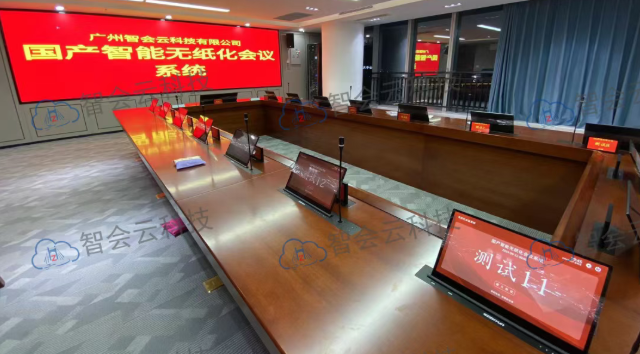
Before the deployment, the organization faced three main challenges.
Unsecured Document Distribution
Meeting materials were distributed through channels that did not provide sufficient security controls.
Collecting or deleting documents after meetings was difficult, increasing the risk of sensitive information remaining outside the organization's control.
Unstable Remote Collaboration
Video delays and audio synchronization problems affected remote participation and reduced communication efficiency between departments.
Fragmented Cross-Department Workflows
Different departments worked with separate document versions and scattered annotations.
Consolidating feedback after each meeting required additional time and manual effort.
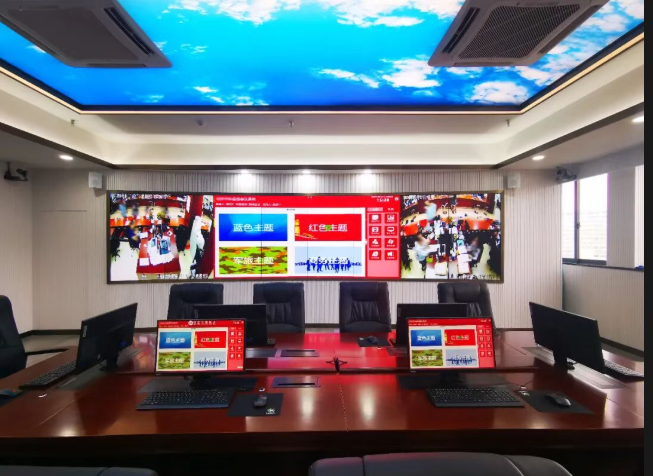
The Deployed Solution
The organization introduced meeting terminals using domestic processors and the Kylin operating system. The software platform was also integrated with the Dameng database.
The completed meeting environment provided:
- Domestic processor-based meeting terminals
- Kylin operating system support
- Domestic database storage
- Encrypted meeting data transmission
- Permission-controlled document distribution
- Unified document versions
- Synchronized document annotation
- Real-time voting
- Online document signing
- Complete operation records
- Searchable meeting archives
Results After Deployment
According to the project results reported by Zhihui Cloud, meeting preparation time was reduced by approximately 70%.
Previously, administrative employees spent a large part of the day collecting materials, checking document formats, printing files, and preparing bound copies.
After deployment, meeting documents could be distributed digitally with unified versions and controlled permissions. Participants could annotate documents on screen, vote in real time, and complete supported signing processes during the meeting.
After each meeting, files could be archived in the domestic database, making meeting information easier to search, review, and trace.
The organization selected the solution after evaluating system performance, feature completeness, security controls, and practical usability.
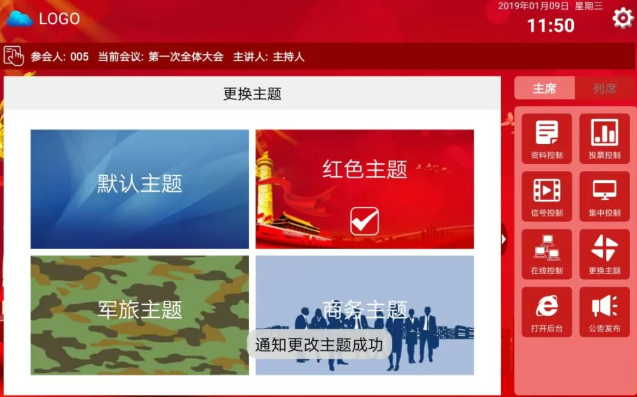
From Technology Replacement to Operational Improvement
The purpose of IT localization should not be limited to replacing imported products.
A successful government meeting system should also improve daily operations by:
- Reducing meeting preparation time
- Eliminating repetitive printing and document binding
- Maintaining consistent document versions
- Protecting confidential meeting materials
- Supporting cross-department collaboration
- Recording votes, annotations, and decisions
- Creating searchable meeting archives
- Separating administrative responsibilities
- Preserving complete audit records
- Reducing dependence on uncontrolled technology platforms
When a domestically compatible system is reliable, secure, and easy to use, technology localization becomes an opportunity to improve overall meeting efficiency.
How to Evaluate a Government Paperless Meeting System
Organizations planning to upgrade their meeting systems should evaluate the entire technology stack rather than focusing only on the user interface.
Important questions include:
1. Which domestic processors does the system support?
2. Has it been optimized for Kylin, UnionTech UOS, or HarmonyOS?
3. Can meeting data be stored in Dameng or KingbaseES databases?
4. Is the platform compatible with domestic middleware?
5. Does the meeting hardware use domestic component solutions?
6. Can administrators define document and participant permissions?
7. Are document uploads, downloads, access, and deletions recorded?
8. Are administrative and auditing responsibilities separated?
9. Can terminal data be cleared after confidential meetings?
10. Does the system support encrypted transmission and private deployment?
11. Can existing meeting data be migrated securely?
12. Is technical support available for full-stack integration?
These questions help organizations distinguish a genuinely domestically compatible meeting system from a product that provides only basic software adaptation.
Building Secure and Controllable Government Meetings
Government meeting systems have become an important part of China's transition toward domestically developed information technology.
Because these platforms process sensitive documents, important decisions, and confidential communications, effective technology localization must extend from processors and operating systems to databases, middleware, applications, terminals, and security management.
Zhihui Cloud's paperless meeting system brings these components together in a unified environment.
Its compatibility with domestic technology platforms, role-based administration, encrypted transmission, operation records, and terminal data-clearing functions help government and enterprise organizations build more secure and controllable meeting workflows.
The objective is not simply to complete a technology replacement project. It is to create a meeting system that is secure, reliable, practical, and ready for long-term use.